How PVC Concrete Cube Moulds Ensure Accurate Results for Compression Testing (CTM) ?
28 Jul 2026
Construction
161
"Learn why concrete cube testing is essential for compressive strength testing using a Compression Testing Machine (CTM). Discover the complete cube testing procedure, curing process, IS standards and the advantages of using PVC Cube Moulds from Mitro Industries."
Concrete is the backbone of every construction project, from residential buildings to skyscrapers, bridges, highways, dams, and industrial structures. While concrete appears strong, its actual performance can only be verified through compressive strength testing.
The Concrete Cube Compression Test is the most widely accepted quality control method for determining whether concrete has achieved its required design strength. This test is performed using a Compression Testing Machine (CTM) after concrete cube specimens have been properly cast, cured, and prepared using a precision PVC Cube Mould.
Without concrete cube testing, engineers cannot accurately determine whether a structure is safe enough to bear the intended loads throughout its service life.
What is Concrete Cube Testing?
Concrete Cube Testing is a laboratory procedure used to measure the compressive strength of hardened concrete.
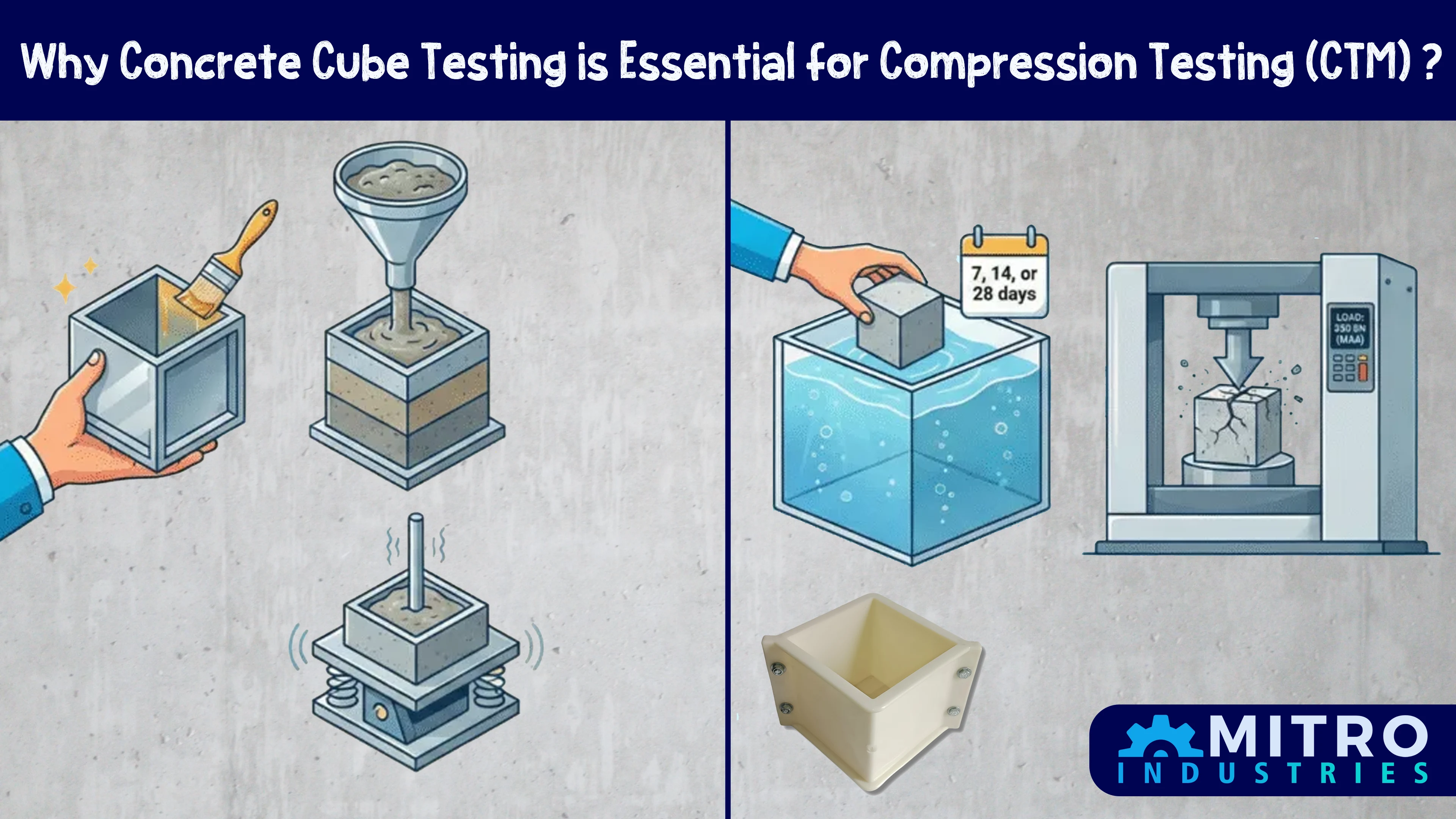
Fresh concrete is poured into a standard cube mould, compacted, cured under controlled conditions, and then subjected to increasing compressive load inside a Compression Testing Machine (CTM) until failure occurs.
The maximum load sustained before failure determines the compressive strength of the concrete.
The formula used is
Compressive Strength (N/mm²) = Failure Load (N) ÷ Loaded Area (mm²)
For a standard 150 mm × 150 mm × 150 mm concrete cube
Cube Face Area = 150 × 150 = 22,500 mm²
This value is compared with the specified concrete grade (M20, M25, M30, etc.) to verify structural quality.
Why is Concrete Cube Testing Important?
Concrete cube testing plays a critical role in construction quality assurance.
1. Verifies Concrete Strength
• The primary purpose of the test is to confirm whether the concrete has achieved the required compressive strength specified in the structural design.
• This ensures the building can safely withstand design loads throughout its lifespan.
2. Ensures Structural Safety
• Weak concrete may develop cracks, excessive deflection, or structural failure.
• Cube testing helps identify poor-quality concrete before it becomes part of a completed structure.
3. Quality Control
Concrete strength can vary because of
• Incorrect water-cement ratio
• Poor mixing
• Low-quality aggregates
• Improper compaction
• Insufficient curing
• Material contamination
Regular cube testing ensures every concrete batch meets project specifications.
4. Compliance with Standards
Concrete cube testing is required by national and international standards, including
• IS Codes
• ASTM Standards
• BS EN Standards
Construction consultants and government agencies often require cube test reports before approving structural work.
5. Detects Construction Errors
Cube testing helps identify issues such as
• Honeycombing
• Segregation
• Excessive water content
• Poor vibration
• Improper batching
Detecting these problems early reduces costly repairs.
6. Improves Project Quality
Consistent testing enables contractors to maintain high construction quality and avoid structural defects.
What is a Compression Testing Machine (CTM)?
A Compression Testing Machine (CTM) is a laboratory machine used to determine the compressive strength of concrete cube specimens.
The machine applies increasing compressive force until the concrete cube fractures.
The highest load recorded represents the failure load used to calculate compressive strength.
CTMs are widely used in
• Civil Engineering Laboratories
• Ready Mix Concrete Plants
• Construction Companies
• Government Testing Laboratories
• Universities
• Infrastructure Projects
Why PVC Cube Mould is Important in Concrete Cube Testing
The accuracy of compressive strength testing depends not only on the CTM but also on the quality of the cube specimen.
A poorly manufactured cube mould can produce inaccurate specimen dimensions, leading to incorrect strength calculations.
This is where PVC Cube Moulds become essential.
What is a PVC Cube Mould?
A PVC Cube Mould is a precision-engineered mould used for casting concrete cube specimens before compression testing.
It provides accurate internal dimensions and smooth surfaces to ensure reliable testing results.
Mitro Industries manufactures high-quality PVC Concrete Cube Moulds that are lightweight, reusable, rust-proof, and easy to maintain.
Standard Cube Mould Sizes
The most common cube mould sizes include
• 150 × 150 × 150 mm - Standard concrete testing
• 100 × 100 × 100 mm - Small aggregate concrete
• 50 × 50 × 50 mm - Laboratory research
Among these, the 150 mm PVC Cube Mould is the industry standard for routine concrete compressive strength testing.
Step-by-Step Concrete Cube Testing Procedure
Step 1 – Clean the PVC Cube Mould
• Before casting, clean the mould thoroughly.
• Remove any dirt, old cement, or debris.
Step 2 – Apply Mould Oil
• Apply a thin layer of mould release oil to the internal surfaces.
• This ensures easy demoulding without damaging cube edges.
Step 3 – Prepare Fresh Concrete
• Mix concrete according to the approved mix design while maintaining the correct water-cement ratio.
Step 4 – Fill the Cube Mould
• Fill the PVC Cube Mould in equal layers.
• Depending on laboratory practice, fill in two or three layers.
Step 5 – Compact Each Layer
Compaction removes trapped air.
This can be done using
• Tamping Rod
• Vibration Table
Proper compaction increases concrete density and improves test accuracy.
Step 6 – Finish the Surface
Level the top surface using a trowel.
Mark the cube with
• Casting Date
• Sample Number
• Mix Grade
• Batch Identification
Step 7 – Initial Setting
• Keep the mould undisturbed for approximately 24 hours.
• Maintain suitable temperature and humidity.
Step 8 – Demould the Cube
• After 24 hours, carefully remove the PVC mould.
• Inspect cube edges for defects.
Step 9 – Water Curing
Immerse the concrete cubes in clean water until testing.
Standard curing durations include
• 7 Days – Early Strength
• 14 Days – Intermediate Strength (optional)
• 28 Days – Final Design Strength
Compression Testing Procedure Using CTM
After curing
• Remove the cube from water.
• Wipe excess surface moisture.
• Position the cube centrally inside the CTM.
• Apply load gradually until failure.
• Record the maximum load.
• Calculate compressive strength.
Importance of Accurate Cube Dimensions
The compressive strength calculation depends directly on the loaded surface area.
Even a small dimensional error can significantly affect the calculated strength.
Therefore, precision cube moulds are essential for reliable results.
Advantages of PVC Cube Moulds
Compared to traditional cast iron moulds, PVC Cube Moulds offer several advantages.
Lightweight
Easy to transport and handle.
Rust-Free
PVC never corrodes, eliminating maintenance associated with steel moulds.
Smooth Surface
Produces better-finished concrete cubes with easier demoulding.
High Dimensional Accuracy
Precision manufacturing ensures consistent cube dimensions.
Reusable
Designed for repeated laboratory use.
Easy Cleaning
Concrete residue can be removed quickly without special treatments.
Cost-Effective
Long service life with minimal maintenance.
Applications of PVC Cube Mould
PVC Cube Moulds are extensively used in
• Civil Engineering Laboratories
• Construction Companies
• Ready Mix Concrete Plants
• Universities
• Quality Control Laboratories
• Government Testing Centers
• Infrastructure Projects
• Bridge Construction
• Highway Projects
• Industrial Plants
• Precast Concrete Factories
Why Choose Mitro Industries PVC Cube Mould?
Mitro Industries manufactures premium-quality PVC Concrete Cube Moulds designed for accurate concrete specimen preparation.
Our moulds feature
• Precision dimensions
• High-strength engineering PVC
• Lightweight construction
• Rust-proof material
• Smooth internal finish
• Long service life
• Easy maintenance
• Reusable design
Popular Posts
-
Why Backer Rod Is Used in Road Construction?
3993 Views



Top View News & Blog