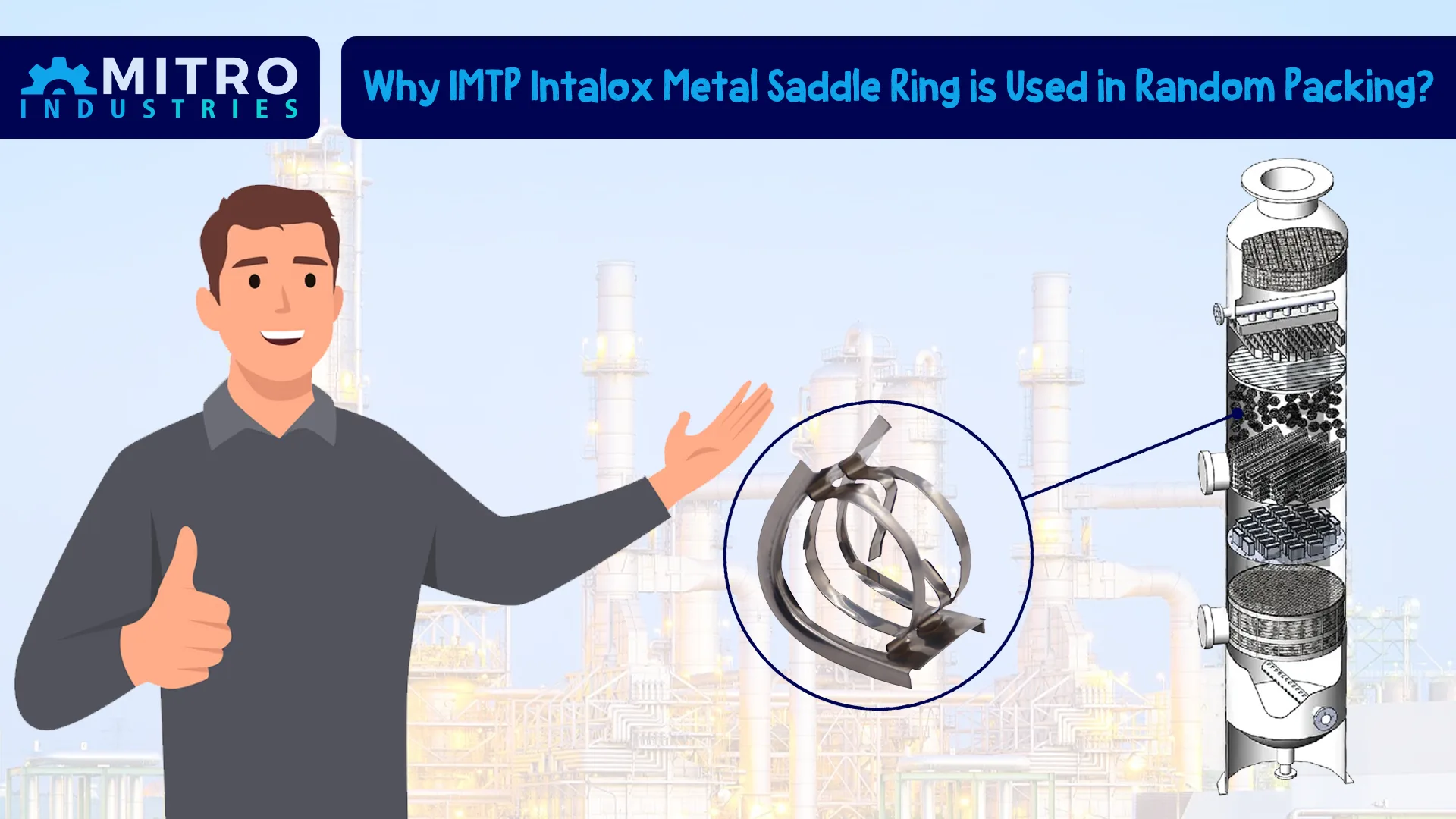
Why IMTP Intalox Metal Saddle Ring is Used in Random Packing?
23 May 2026
Oil and Gas
3762
"Learn why IMTP Intalox Saddle Ring is called third-generation tower random packing and how it offers better efficiency, lower pressure drop, and higher capacity compared to Pall Rings in distillation and absorption columns."
Random packing plays a vital role in mass transfer operations such as distillation, absorption, stripping, and gas scrubbing. Among the many types of tower packings available, the IMTP Metal Saddle Ring has become one of the most preferred high-performance random packings in modern chemical industries. It was developed as an advancement over the traditional Pall Ring to improve column efficiency, reduce pressure drop, and increase capacity.
What is Random Packing?
Random packing consists of small packing elements dumped randomly inside a tower or column to create a large surface area for gas-liquid contact. The objective is to improve mass transfer efficiency while minimizing pressure drop and energy consumption. Common random packings include Raschig Rings, Pall Rings, Berl Saddles, and IMTP Saddles.
What is an IMTP Metal Saddle Ring?
The IMTP (Intalox Metal Tower Packing) Saddle Ring is a high-performance random packing developed in the late 1970s. It combines the advantages of saddle-shaped packing with modern ring-type packing technology. Its unique geometry provides better liquid distribution, high void fraction, and low resistance to vapor flow.
Unlike conventional cylindrical packings, the IMTP saddle has a low-aspect-ratio saddle shape that promotes better orientation and random distribution inside the tower. This creates more effective gas-liquid contact and improved hydraulic performance.
Why IMTP Metal Saddle Ring is Used in Random Packing
1. Lower Pressure Drop
One of the biggest reasons industries prefer IMTP packing is its exceptionally low pressure drop. The open saddle geometry allows vapor to pass through more freely compared to conventional packings.
Lower pressure drop means
• Reduced energy consumption
• Better vacuum operation
• Improved column throughput
• Lower operating costs
Studies and industrial references show that IMTP saddles can provide significantly lower pressure drop than Pall Rings under similar operating conditions.
2. Higher Mass Transfer Efficiency
Efficient separation depends on effective contact between liquid and vapor phases. The IMTP saddle provides
• Better liquid spreading
• Uniform wetting
• Continuous surface renewal
• Larger effective surface area
This improves the overall mass transfer coefficient and increases separation efficiency in absorption and distillation processes.
3. High Capacity Operation
The unique shape of IMTP packing creates a very high void fraction, allowing higher vapor and liquid loading without flooding.
Benefits include
• Increased tower capacity
• Ability to process higher flow rates
• Reduced column diameter requirement
• Improved operational flexibility
High-capacity operation is especially important in petrochemical plants, gas treatment units, and refinery towers.
4. Excellent Mechanical Strength
Metal IMTP saddles are usually manufactured from stainless steel, duplex steel, titanium, or special alloys.
They possess excellent
• Mechanical durability
• Corrosion resistance
• Thermal stability
• Resistance to fouling
This makes them suitable for harsh chemical environments and high-temperature applications.
5. Better Liquid Distribution
The saddle geometry encourages multidirectional liquid flow and minimizes channeling.
Better liquid distribution improves
• Wetting efficiency
• Contact time
• Overall separation performance
This is particularly useful in gas sweetening, acid gas removal, and vacuum distillation columns.
Advancement of IMTP Saddle Ring Over Pall Ring
The Pall Ring was itself an improvement over the older Raschig Ring. It introduced windows and internal tabs to improve gas-liquid contact and reduce pressure drop. Pall Rings became widely used because they offered better efficiency and capacity than Raschig Rings.
However, IMTP Saddle Rings were later developed as a third-generation high-performance random packing to overcome some limitations of Pall Rings.
Key Advancements of IMTP Over Pall Ring
1. Improved Geometry
The most important advancement is the saddle-shaped structure. Pall Rings use a cylindrical design with punched openings, whereas IMTP packing uses an aerodynamic saddle geometry.
This shape
• Reduces drag
• Improves fluid dynamics
• Enhances turbulence
• Promotes better liquid redistribution
As a result, IMTP achieves higher efficiency with lower energy loss.
2. Lower Liquid Hold-Up
IMTP packing has lower liquid hold-up compared to Pall Rings.
Lower hold-up means
• Faster mass transfer
• Reduced residence time
• Better vacuum performance
• Lower pressure drop
This makes IMTP especially valuable in vacuum distillation towers.
3. Better Performance at High Loads
At high vapor and liquid loads, Pall Rings may experience channeling and reduced efficiency. IMTP saddles maintain stable performance because of their improved random orientation and open structure.
Therefore, IMTP packing is preferred in
• Refinery fractionators
• Gas processing plants
• Petrochemical columns
• High-capacity absorbers
4. Higher Capacity-to-Pressure-Drop Ratio
A major engineering advantage of IMTP packing is its excellent balance between capacity and pressure drop.
Engineers can achieve
• Higher throughput
• Smaller tower size
• Lower operating cost
• Improved productivity
This advancement has made IMTP one of the most widely adopted premium random packings in modern process industries.
Applications of IMTP Metal Saddle Ring
IMTP packing is widely used in
• Distillation columns
• Absorption towers
• Scrubbers
• Gas sweetening units
• Acid gas removal systems
• Vacuum distillation towers
• Petrochemical plants
• Fertilizer industries
• Refineries
• Environmental treatment systems
The IMTP Metal Saddle Ring represents a major technological advancement in random packing design. By combining the advantages of saddle geometry with modern high-performance packing concepts, IMTP offers superior efficiency, lower pressure drop, higher capacity, and better liquid distribution than traditional Pall Rings.
While Pall Rings remain widely used due to their simplicity and cost-effectiveness, IMTP Saddle Rings are preferred in demanding industrial applications where maximum performance, energy savings, and operational reliability are critical.
For modern distillation, absorption, and gas treatment systems, IMTP packing has become one of the most efficient and reliable random packing solutions available today.
IMTP Intalox Saddle Ring is widely recognized as a third-generation tower random packing in mass transfer technology.
Why IMTP Intalox Saddle Ring is Called Third-Generation Random Packing
The IMTP (Intalox Metal Tower Packing) Saddle Ring was developed as an advanced improvement over earlier random packings such as
• First Generation : Raschig Ring
• Second Generation : Pall Ring
• Third Generation : IMTP Intalox Saddle Ring
The IMTP packing combines the advantages of
• Saddle-shaped packing geometry
• High void fraction
• Optimized vapor-liquid contact
• Improved hydraulic performance
This advanced design provides
• Lower pressure drop
• Higher mass transfer efficiency
• Better liquid distribution
• Greater tower capacity
• Improved fouling resistance
Compared to Pall Rings, IMTP Intalox Saddle Rings offer significantly better performance in modern distillation, absorption, stripping, and scrubbing applications.
Popular Posts
-

Why Backer Rod Is Used in Road Construction?
3993 Views

Top View News & Blog